







Does your child cover their ears at the hand dryer, refuse to wear certain clothes, or seem to be constantly on the move?
Many parents notice these things and wonder whether they matter. Sometimes they are just part of growing up. Sometimes they are signs that your child is finding it hard to process what their senses are telling them. With a better understanding of sensory processing, it can become easier to recognise what your child may be experiencing and how to support them at home, at school and in everyday life.
What is sensory processing?
Sensory processing is how our brain takes information from our senses, makes sense of it, and decides how to respond. It happens all day, mostly without us noticing [1]. Most of us know the five senses: sight, hearing, touch, taste and smell. There are three more that matter just as much:
- Vestibular: our sense of balance and movement, from the inner ear
- Proprioception: our sense of where our body is and how much force we are using, from muscles and joints
- Interoception: our sense of what is happening inside the body, such as hunger, thirst or needing the toilet [1]
When sensory processing works smoothly, a child can filter out background noise, sit comfortably in class and cope with a busy classroom. When it is harder, everyday places and tasks can feel overwhelming, or not stimulating enough [1,2].
How do I know if my child is having difficulties?
Every child has likes and dislikes. Sensory differences become a concern when they get in the way of everyday life: eating, dressing, sleeping, learning, playing or joining in with family life [2].
Children often fall into one or more of these patterns [1].
Over-responsive (sensitive to sensations)
- Upset by loud or sudden noises, such as hand dryers, sirens or busy classrooms
- Bothered by clothes, labels, seams, socks or having their hair washed or cut
- A very limited diet because of food textures or smells
- Avoids messy play, sand, paint or getting their hands dirty
- Becomes overwhelmed in busy places and has meltdowns afterwards
Under-responsive (needs more to notice)
- Does not seem to notice when they are hurt, messy or called by name
- Seems tired, slow to get going or “switched off”
- Does not notice when they are hungry or need the toilet
Sensory seeking (looks for more input)
- Always moving, spinning, jumping, crashing or climbing
- Chews clothes, pencils or toys
- Touches everything and everyone
- Plays roughly without meaning to
Meltdowns are a common sign. They are not the same as tantrums. A meltdown often happens when a child’s nervous system has had more than it can manage, and it is not something they can control in the moment [3].
Sensory processing differences are common in autistic children and children with ADHD, but they can also happen on their own. “Sensory processing disorder” is not a formal diagnosis in the UK, but the difficulties are real, and an occupational therapist can assess and support them [1,4].
What does a sensory processing assessment involve?
A sensory processing assessment with a Better Days occupational therapist usually includes:
- A conversation with you. We ask about your child’s development, daily routines, what they find hard and what helps. You know your child best.
- Standardised questionnaires. Parents, and often teachers, complete questionnaires such as Sensory Profile 2. These compare your child’s responses with other children of the same age, at home and at school [4,5].
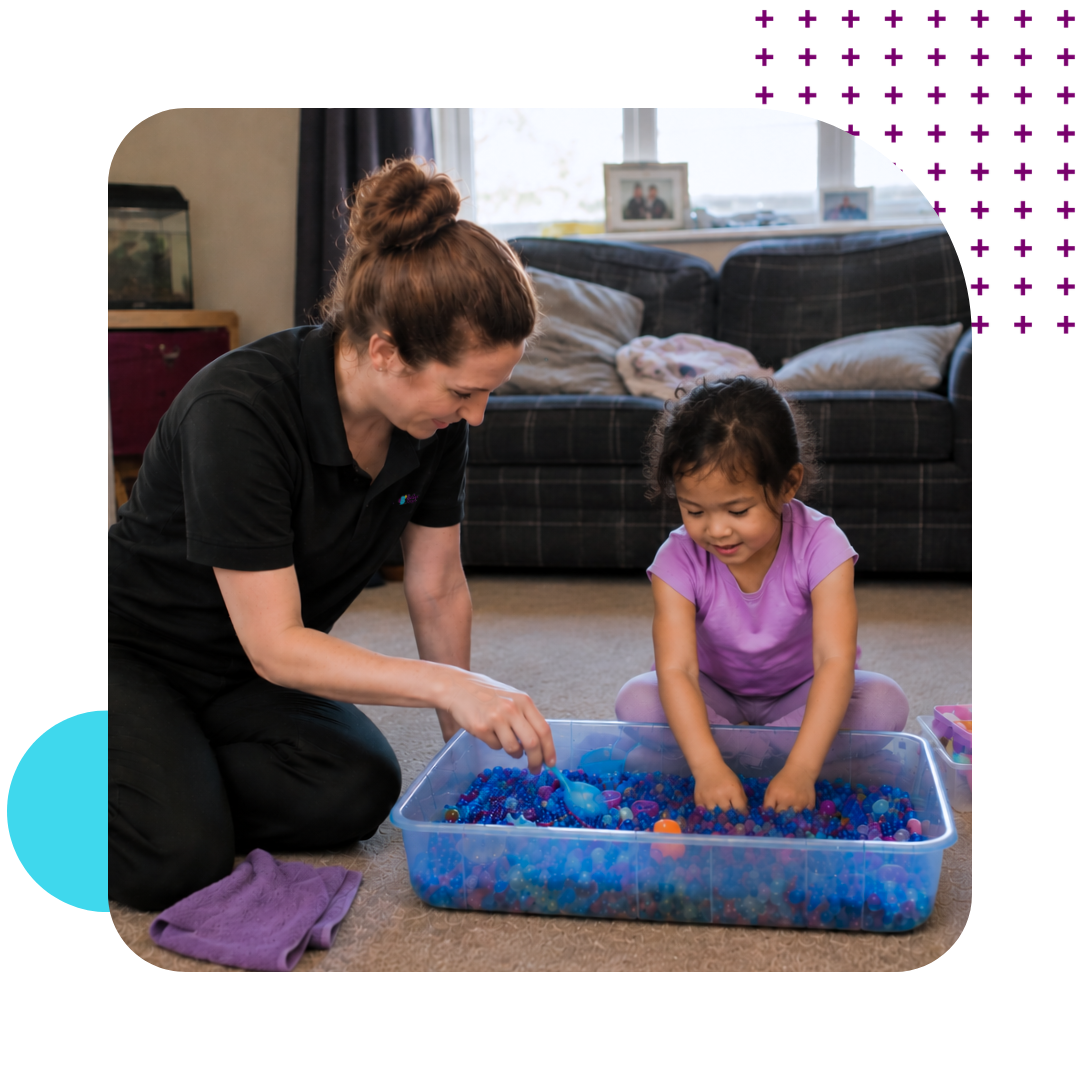
- Play-based observation. The OT watches how your child moves, plays and responds to different sensations. It feels like playing to your child, not a test.
- A look at related skills. Sensory difficulties often affect balance, coordination, handwriting and attention, so we check these too [2,4,5].
- A school or home visit, if needed. To observe your child in another setting.
- A written report. You receive a clear report explaining your child’s sensory profile and practical recommendations for home and school.
The report can be used to support an EHCP request or to help school understand your child’s needs [6].
What happens after the assessment?
Support depends on what we find, and might include [2,7]:
- a sensory diet, a personalised plan of activities throughout the day that helps your child feel calm, alert and ready to learn
- changes at home and school, such as ear defenders, a quiet space, movement breaks or seamless clothing
- strategies for managing overwhelm and preventing meltdowns
- ongoing occupational therapy sessions
- training and advice for school staff
Some sensory differences ease with age. Many children benefit from practical ways that help them feel more comfortable, confident and able to take part in everyday life. An assessment helps you understand what your child needs to feel supported across the environments that matter most [2,4,7].
How can Better Days help?
Understanding your child’s sensory needs can make everyday experiences feel more manageable for both you and your child. Our occupational therapists take the time to build a clear picture of your child’s strengths, challenges and preferences. Assessments can take place in our clinic, at home, or in school.
If you’d like to explore whether a sensory processing assessment is right for your child, book an assessment, contact our team, or call us at 07999 845028. We’d be happy to talk through your concerns and answer any questions you may have.
References
- Berkshire Healthcare NHS Foundation Trust. Sensory processing disorder [Internet]. [cited 2026 Nov 17]. Available from: https://www.berkshirehealthcare.nhs.uk/conditions/sensory-processing-disorder
- Royal College of Occupational Therapists. Using sensory integration therapy, sensory-based interventions and sensory approaches with children and young people [Internet]. London: RCOT; 2026 [cited 2026 Nov 17]. Available from: https://www.rcot.co.uk/sites/default/files/2026-03/RCOT_Guidance%20-%20Using%20sensory%20integration%20therapy%20with%20children%20and%20young%20people%20-%20March%202026_0.pdf
- Norfolk Community Health and Care NHS Trust. Meltdowns and distressed behaviour [Internet]. [cited 2026 Nov 17]. Available from: https://www.justonenorfolk.nhs.uk/nd-digital-library/social-emotional-development/meltdowns-and-distressed-behaviour
- Little LM, Dean E, Tomchek S, Dunn W. Sensory processing patterns in autism, attention deficit hyperactivity disorder, and typical development. Phys Occup Ther Pediatr. 2018;38(3):243–254. Available from: https://doi.org/10.1080/01942638.2017.1390809
- Wrightington, Wigan and Leigh Teaching Hospitals NHS Foundation Trust. Children’s occupational therapy service [Internet]. [cited 2026 Nov 17]. Available from: https://www.wwl.nhs.uk/childrens-occupational-therapy-service
- The Special Educational Needs and Disability Regulations 2014, SI 2014/1530, regulation 6 [Internet]. London: The National Archives; 2014 [cited 2026 Nov 17]. Available from: https://www.legislation.gov.uk/uksi/2014/1530/regulation/6
- Piller A, McHugh Conlin J, Glennon TJ, Andelin L, Auld-Wright K, Teng K, et al. Systematic review of sensory-based interventions for children and youth (2015–2024). Front Pediatr. 2025;13:1720179. Available from: https://doi.org/10.3389/fped.2025.1720179