







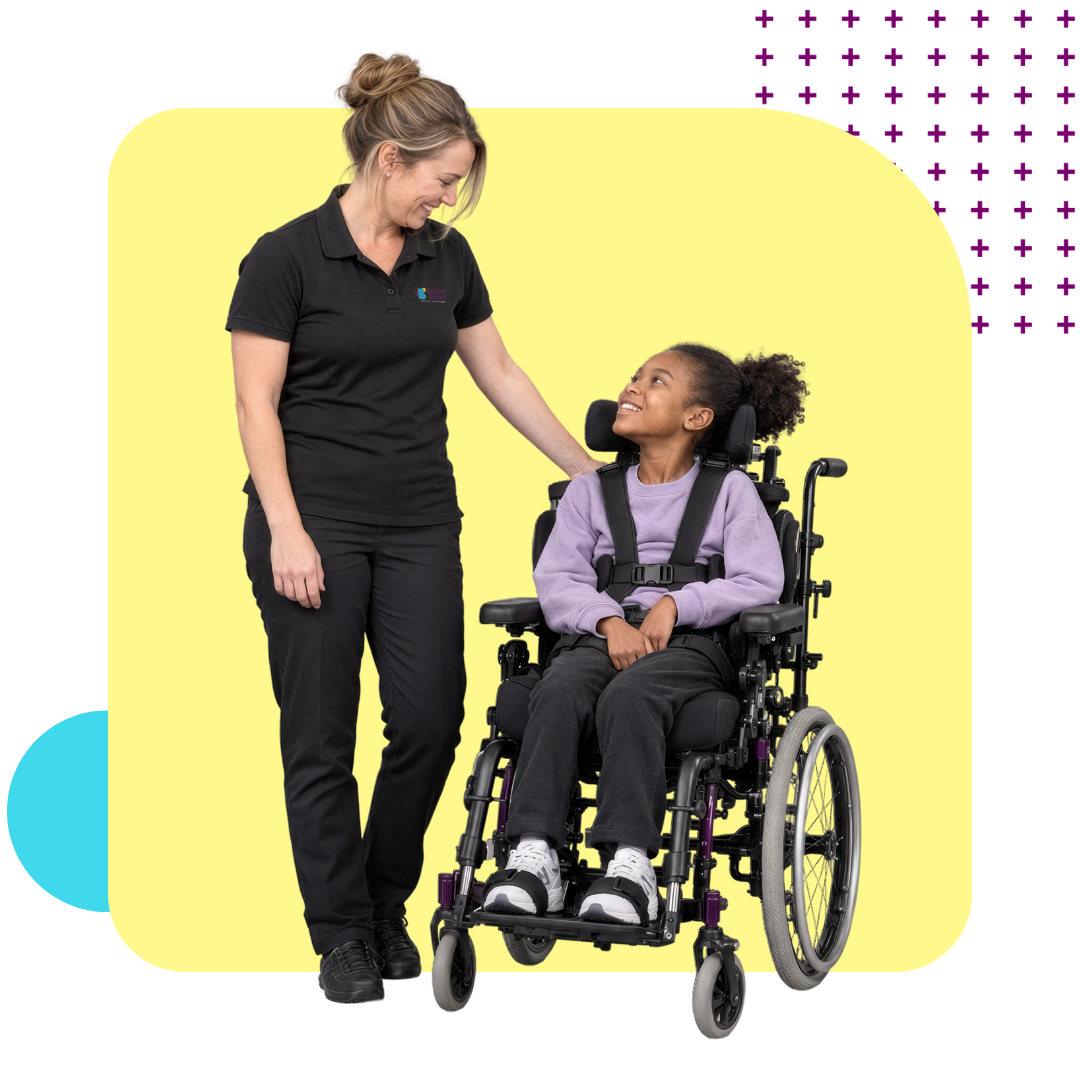
The right wheelchair or seat can change everything. It can mean sitting comfortably through a school day, getting around independently, joining in with family life, or avoiding pain and pressure sores. The wrong one can do the opposite [1,2]. A wheelchair and seating assessment with an occupational therapist makes sure the equipment fits the person, their body and their life [1].
What is a wheelchair and seating assessment?
A wheelchair and seating assessment is a detailed look at a person’s posture, movement, comfort and daily life. The occupational therapist then recommends the right equipment and how it should be set up. This might include [1,2]:
- a manual or powered wheelchair
- a specialist seating system, cushion or backrest
- a supportive chair for home, school or work
- accessories such as headrests, lateral supports, harnesses or trays
- advice on 24-hour postural management, meaning how a person is supported when sitting, standing and lying down, including at night [3]
Who is this assessment for?
Children and young people
Children who use wheelchairs or specialist seating, for example because of cerebral palsy, muscular dystrophy, spina bifida or other physical disabilities, need their equipment reviewed regularly as they grow. Good seating helps with [3,4]:
- posture and preventing problems such as hip or spine changes
- comfort, so they can concentrate in class
- using their hands for play, eating and learning
- communication, breathing and swallowing
- getting around as independently as possible
Because children grow and their needs change, seating is recommended to be reviewed regularly. Many children need a review at least once a year, or sooner after a growth spurt or surgery [5].
Adults
Adults may need an assessment after an injury such as a spinal cord or brain injury, with a progressive condition such as MS or motor neurone disease, after a stroke, or when getting older makes walking harder. A review is also useful when [1,2]:
- a current chair is uncomfortable or causing pain
- a person keeps sliding or leaning in their chair
- there is a risk of pressure sores [6]
- needs have changed, or a powered chair might bring more independence
How is an NHS or private assessment involved?
The NHS provides wheelchairs through local wheelchair services, usually after a referral from a GP or another health professional. Eligibility rules vary between areas. In England, people who are eligible for an NHS wheelchair have the right to a personal wheelchair budget, which can be put towards a chair that better suits their needs [7,8].
People choose a private occupational therapy assessment when they:
- face a long wait for NHS wheelchair services
- want independent advice before buying a chair privately
- need equipment for a setting the NHS may not cover, such as school seating, work or sport
- need a detailed report for a personal injury claim or case manager
A private assessment can work alongside NHS services, and our report can be shared with your wheelchair service. You may also use our detailed OT report to support applications for wheelchair budget or charity funding [7,8].
What happens during an OT wheelchair and seating assessment?
A wheelchair or seating assessment helps us understand your physical needs, daily activities and the environments where equipment will be used. At Better Days, OT assessments usually include [1,2]:
- Getting to know the person. We talk about health, daily routine, goals and what is not working now. For children, we speak with parents and often school.
- Looking at where the chair will be used. Home, school, work, transport and the car all affect what will work. We may visit, or ask for photos and measurements.
- Physical assessment. The OT assesses posture, joint movement, strength, balance and skin health, usually with the person both sitting and lying on a mat or plinth. This shows what support the body needs.
- Measurements. We take accurate body and equipment measurements.
- Trying equipment. Where possible, the person tries different chairs, cushions and supports. We often work with specialist suppliers for this.
- A written report and prescription. You receive a report explaining what is recommended and why, with specifications that can be used for funding applications or to order equipment [1,7].
- Handover and review. When the equipment arrives, we can check it is set up correctly, show you how to use it and review how it is working.
Better Days recommends equipment based on the person’s individual needs, goals and environment. We will not recommend or advertise a specific brand. We can suggest suitable options from a range of suppliers and provide independent recommendations to help you make informed decisions about equipment and funding. An assessment usually takes around 2 hours.
How can Better Days help?
Our occupational therapists provide wheelchair and seating assessments for children, young people and adults across Greater London.
Get in touch to discuss your needs, book a wheelchair and seating assessment, or call us at 07999 845028. Our team would be happy to answer your questions and discuss the support available.
References
- World Health Organization. Wheelchair provision guidelines [Internet]. Geneva: World Health Organization; 2023 [cited 2026 Nov 17]. Available from: WHO
- Royal College of Occupational Therapists. Living well in care homes: seating and positioning [Internet]. London: RCOT; [cited 2026 Nov 17]. Available from: RCOT
- Cambridgeshire and Peterborough NHS Foundation Trust. Postural care and management [Internet]. Cambridge: CPFT; [cited 2026 Nov 17]. Available from: CPFT NHS Trust
- East London NHS Foundation Trust. Specialist seating [Internet]. London: ELFT; [cited 2026 Nov 17]. Available from: East London NHS Foundation Trust
- University Hospitals Birmingham NHS Foundation Trust. Physical Needs Team frequently asked questions [Internet]. Birmingham: UHB; [cited 2026 Nov 17]. Available from: Solihull Children’s Community Therapies
- National Institute for Health and Care Excellence. Pressure ulcers: prevention and management. Clinical guideline CG179 [Internet]. London: NICE; 2014 [updated 2025; cited 2026 Nov 17]. Available from: NICE
- NHS England. Personal wheelchair budgets [Internet]. London: NHS England; [cited 2026 Nov 17]. Available from: NHS England
- NHS England. Personal wheelchair budgets: frequently asked questions [Internet]. London: NHS England; [cited 2026 Nov 17]. Available from: NHS England